


Discover Top-Rated Transportation Medical Services in Tampa: Your Comprehensive Guide
- Marqus Johnson

- Sep 2, 2024
- 8 min read
Updated: May 1

Marqus Willard Johnson, PMP|Founder & Principal Operator · Wheelchair & Stretcher Transportation Services|Tampa, FL · 813-924-8156
The Short Answer
When a patient misses care, the problem often starts long before the exam room. In Tampa Bay, missed dialysis sessions, delayed hospital discharges, and chaotic cancer appointments frequently trace back to one failure point: unreliable medical transportation. After coordinating 1,000+ patient transports across Tampa Bay — including regular work with discharge teams at Tampa General Hospital and Moffitt Cancer Center — I've seen this pattern more times than I can count.
This guide explains what transportation medical services actually are, who needs them, how to choose a provider, and what separates a safe NEMT operation from a van with a phone number.
In This Guide
What Are Transportation Medical Services in Tampa Bay?
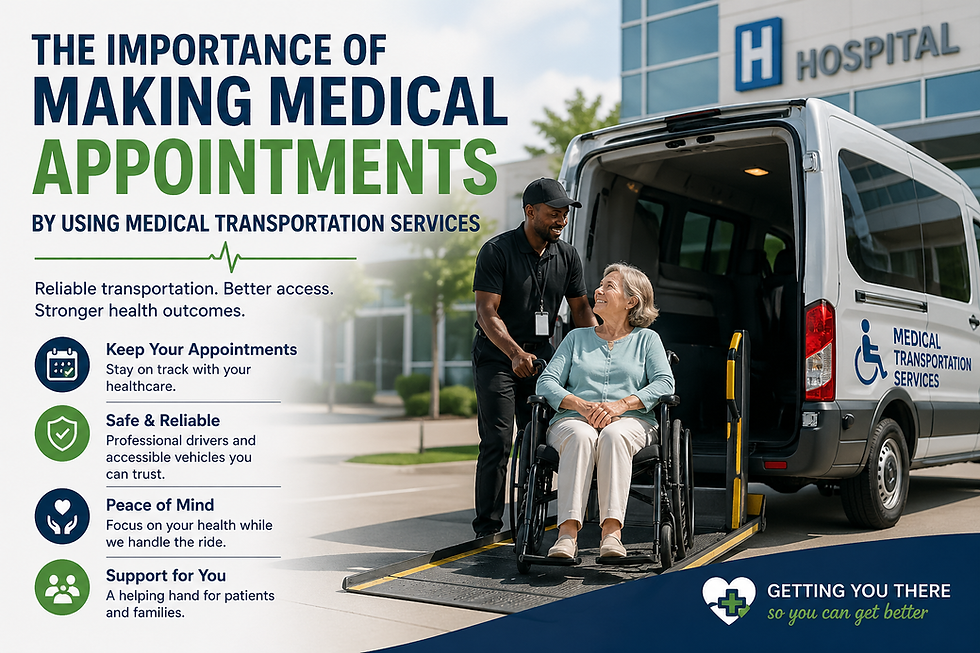
Transportation medical services are specialized ride options for patients who need help getting to and from hospitals, medical offices, dialysis clinics, rehab centers, and treatment facilities. These services exist because many patients simply cannot safely use a family vehicle, a taxi, or a standard rideshare — and a standard rideshare driver isn't trained, equipped, or licensed to help when they can't.
The most common types:
Non-Emergency Medical Transportation (NEMT)
For patients who need scheduled medical appointments but don't require ambulance-level emergency care.
Wheelchair Transportation
For manual or power wheelchair users who need lift- or ramp-equipped vehicles with ADA four-point securement.
Stretcher Transport
For patients who must remain flat during transport. Not ambulance care — a specific vehicle configuration for non-emergency needs.
Ambulatory Transport
For patients who can walk with assistance but still need help and reliable scheduling.
Specialized Medical Transport
Bariatric patients, oxygen-dependent riders, complex mobility situations, and long-distance medical transport.
Wix/SEO Note
Internal link each service type to its dedicated service page: wheelchair transportation, stretcher transport, and NEMT services pages respectively.
Why Does Tampa Bay Rely So Heavily on Medical Transportation?
Because transportation is a real healthcare access issue — not a convenience problem. Research consistently links transportation barriers to delayed or missed care, particularly for older adults and patients managing chronic illness.
Tampa Bay amplifies this challenge. The region includes major hospitals, outpatient treatment centers, dialysis clinics, rehab facilities, and one of Florida's largest senior populations — and those populations are geographically spread across Hillsborough, Polk, Manatee, Highlands, and Hardee Counties. When a patient depends on recurring appointments, transportation directly affects treatment adherence, discharge timing, and health outcomes.
1,000+patient transports coordinated across Tampa Bay
5counties served: Hillsborough, Polk, Manatee, Highlands, Hardee
7days a week — including same-day urgent runs
In our operations, some of the most urgent calls come from families who assumed Uber or a relative's SUV would work — until discharge staff explained the patient couldn't safely travel that way. That misunderstanding causes more same-day chaos than almost anything else.
What Types of Patients Use NEMT in Tampa Bay?
Far more people than most families realize. Here are the most common riders we serve:
Seniors who can no longer transfer safely into a standard vehicle
Wheelchair users — manual, power, and bariatric — who need lift-equipped vans with ADA securement
Post-surgical patients being discharged from Tampa General Hospital, St. Joseph's, AdventHealth, or other facilities
Dialysis patients with recurring, scheduled ride needs across the week
Cancer patients traveling to Moffitt Cancer Center for infusion, radiation, or follow-up appointments
Rehab or skilled nursing patients moving between care settings
Patients needing long-distance medical transport — private-pay complex runs beyond the local service area
From Our Dispatch Log
Some of our most stressful rides start because a well-meaning family member assumed the patient could ride in a regular car "just this once." Discharge nurses know better — but by the time they flag it, the family's already on the way. If there's any question about whether a patient needs specialized transport, call us before the discharge date, not the morning of.
How Do You Choose the Right Medical Transportation Service in Tampa Bay?
Choose based on safety, fit, and coordination — not just price. A cheaper ride that shows up late, can't load the wheelchair, or leaves the patient curbside will cost far more in stress, missed care, and potential readmissions.
Confirm the company offers wheelchair and/or stretcher transport — not just "accessible vehicles"
Ask how they handle hospital discharges and whether they coordinate directly with facility staff
Verify the service area — specifically the hospital, clinic, or home address involved
Ask about driver training: patient handling, CPR certification, wheelchair securement protocol
Check reviews for punctuality, communication, and professionalism — not just vehicle quality
Confirm the provider understands recurring rides, will-call returns, and same-day discharge delays
Provider Comparison
Factor | Our Approach | Typical Alternative | Patient Impact |
Scheduling | Phone coordination + structured booking intake for urgent and planned rides | Limited-hour scheduling or basic online form | Faster discharge planning, fewer booking errors |
Vehicle type | Wheelchair + stretcher + complex trip planning | Wheelchair only or limited vehicle options | More appropriate transport for fragile patients |
Coordination | Direct communication with hospitals, facilities, and families | Patient-managed handoff, minimal follow-up | Reduced delays, smoother transitions of care |
Intake process | Mobility, stairs, oxygen, room number, return trip — all clarified up front | Basic address and time only | Fewer failed pickups, safer transport |
Discharge support | Built around real discharge delays and nurse/case manager timing | Curbside-style pickup logic | Less waiting, less confusion, less patient fatigue |
Post-arrival confirmation | Timestamped confirmation to referring case manager on every stretcher run | Not offered | Closed care coordination loop, reduced readmission risk |
For Case Managers & Discharge Planners
We work directly with discharge teams at Tampa General Hospital and Moffitt Cancer Center. Every stretcher transport includes a 30-minute post-arrival confirmation — a timestamped record that the patient reached the receiving facility and the care coordination chain is intact. If your patients are missing follow-up appointments because transport isn't showing up, that's a readmission risk. Call us to discuss a standing referral arrangement: 813-924-8156.
How Much Do Transportation Medical Services Cost in Tampa Bay?
Costs vary based on the type of transport, distance, timing, and level of assistance required. Wheelchair transport typically costs less than stretcher transport; non-emergency trips cost less than ambulance transport.
Transport type: wheelchair vs. stretcher vs. ambulatory
Distance and drive time from pickup to destination
Scheduling: same-day or after-hours bookings carry a premium
Wait time for discharge completion or appointment wrap-up
Extra attendants or specialized equipment (oxygen, bariatric)
Long-distance planning for runs beyond Hillsborough County
Some services are private pay. Others may involve Florida Medicaid managed care or transportation benefits depending on eligibility. We accept private pay and Florida Medicaid. Call 813-924-8156 for current rates on specific trip types.
Don't Optimize for Cheapest
A ride that saves $20 but doesn't show up, can't load the chair, or leaves the patient on the curb costs far more downstream — in rebooking, missed appointments, and the patient stress that follows. Safe transport is the minimum. Reliable transport is what actually matters.
How Should Families Book Medical Transportation in Tampa Bay?
Book earlier than you think necessary — and give more detail than feels required. That one habit prevents more problems than anything else in this process.
1
Confirm the exact appointment or discharge details first
Date, time, facility name, specific building or floor. Discharge times are often estimates — know your window before you call.
2
Share the patient's mobility status clearly
Wheelchair (manual or power), stretcher, ambulatory, oxygen-dependent, transfer assist level, chair model and weight if power chair.
3
Provide full pickup details
Room number, building entrance, gate code if applicable, stairs or elevator situation, caregiver contact name and number.
4
Confirm destination details
Hospital building, clinic entrance, home address with any access notes. Don't assume the driver knows the layout.
5
Ask how the return trip works
Will-call returns, fixed return times, and after-hours pickups all have different logistics. Confirm before the first ride, not after.
6
Reconfirm the day before for recurring appointments
Especially for dialysis and cancer treatment schedules. A quick confirmation call closes gaps before they become crises.
What Safety Features Should a Tampa Bay Medical Transport Provider Have?
At minimum, a provider needs the right vehicle equipment, trained staff, and a process for safe loading, securement, and communication. A ride is only "on time" if it's also safe — a distinction families sometimes don't realize until they've had one bad experience.
Lift- or ramp-equipped vehicles for wheelchair users — not just a "spacious" van
ADA four-point wheelchair securement systems, properly used
Stretcher-capable vehicles when the patient needs to remain reclined
Driver training in patient transfers, safe handling, and emergency response basics
Clear sanitation protocols between patients
Licensed NEMT provider status under Florida regulations — not just a contractor with a vehicle
Rideshare Is Not NEMT
Uber WAV and Lyft accessible vehicles are not non-emergency medical transport. WAV drivers face no training requirement beyond a basic vehicle certification. Securement technique, patient handling, and transfer assistance aren't tested. Florida's rideshare regulations (FLHSMV TNC rules) explicitly exclude WAV drivers from NEMT standards — and no rideshare platform provides stretcher transport under any circumstance.
What Makes Our Tampa Bay Approach Different?
We treat transportation as the last mile of care. Not a drop-off service — a continuation of the patient's treatment plan. The ride connects the patient to the care. When the ride fails, the care fails.
After scaling multiple NEMT operations to six-figure revenue, I learned that the biggest failures almost always happen at the handoff points:
Hospital room to vehicle — does the driver know which floor and which entrance?
Vehicle to clinic — is the driver waiting at the door or on the curb?
Discharge order to actual departure — is transport booked before the order is written, or the morning of?
Recurring ride schedule to real-world punctuality — does the driver account for Tampa morning traffic or just MapQuest the ETA?
That's why our intake process captures mobility details, access information, and return trip logistics before the first ride is ever dispatched. It's why we communicate directly with nurses and case managers instead of leaving the handoff to the patient. And it's why over 1,000 transports in Tampa Bay — including regular coordination with Moffitt Cancer Center and Tampa General Hospital — have given us a clear picture of what actually breaks down and what prevents it.
Community Roots & Professional Standing
Marqus Johnson's founding story and approach to NEMT operations were featured in Voyage Tampa's community highlights series — a recognition of the company's real roots and accountability in the Tampa Bay community. The business is verified through the Hillsborough Black Chamber of Commerce and listed with the Upper Tampa Bay Chamber of Commerce — independent verification of professional standing and local accountability that matters to healthcare providers doing vendor due diligence.
See the Service Before You Book
If you're a case manager evaluating vendors, a family member trying to understand what professional NEMT actually looks like, or a patient who wants to see the vehicle and process before committing — watch the overview below. It covers the lift-equipped van operation, the securement process, and what door-through-door service means in practice across the Tampa Bay corridor.
What Should You Do Next?
If you're planning a discharge, scheduling recurring dialysis transport, or booking wheelchair transportation to a specialist — don't wait until the last minute. The lift-equipped vehicle supply in Tampa Bay is real and finite. On busy discharge days and peak cruise weekends, same-day availability isn't guaranteed.
The best next step: identify upcoming rides now, match the transport type to the patient's actual condition, and confirm a booking process that accounts for real Tampa Bay logistics — not idealized ones.
Reliable transportation medical services in Tampa Bay don't just move patients. They protect treatment plans, reduce stress, and make care actually happen.
Related reading: Wheelchair Transportation from TPA: Airport, Cruise Port & Attractions Guide · Hospital Discharge Logistics & PMP-Governed NEMT · Tampa Wheelchair Transport: Your Safe Ride NEMT Guide
About the Author
Marqus Willard Johnson, PMP is a certified Project Management Professional and healthcare transportation operator who has launched and scaled multiple NEMT businesses to six-figure revenue. He has coordinated 1,000+ patient transports across Tampa Bay, specializing in hospital discharge logistics, private-pay wheelchair and stretcher transportation, and complex medical transport planning.
He has worked directly with hospitals including Tampa General Hospital and Moffitt Cancer Center on transport coordination, discharge workflow support, and patient logistics. His founding story was featured in Voyage Tampa's community highlights. He is an active member of the Hillsborough Black Chamber of Commerce and listed with the Upper Tampa Bay Chamber of Commerce.



Comments