


Tampa wheelchair transport: your safe ride & NEMT guide

Updated: Aug 27
I've coordinated over 1,000 patient transports across Tampa Bay. And if there's one thing I see over and over, it's this: families treating medical transportation like an afterthought — something to arrange the day before, with whoever answers the phone first. This guide exists to change that. Whether you're booking for the first time or vetting a new provider, here's what you actually need to know.

Serving Hillsborough, Polk, Manatee, Highlands & Hardee Counties | Private pay only
What is non-emergency medical transportation — and why does the distinction matter?
Non-emergency medical transportation (NEMT) is a regulated, specialized transport category for patients who need medical-grade assistance but don't require emergency services. Think wheelchair-accessible vehicles, stretcher transport, trained drivers, and proper ADA-compliant securement — none of which a ride-share can legally or safely provide.[1]
Here's the thing: for most appointments, running 15 minutes late is annoying. For a dialysis patient, it can blow a machine slot and cascade into the next patient's treatment window.[2] For someone being discharged from Tampa General after a procedure, a driver who waits in the lobby instead of coming to the room isn't providing safe transport — they're just transferring liability to the family. I've watched both scenarios play out more times than I'd like, and they're entirely preventable.
If you need a ride now: Call 813-924-8156. We run seven days a week. Same-day wheelchair transport is usually available if you call before noon. Stretcher transport needs 24–48 hours heads-up.
Why can't a rideshare driver just help my family member?
Honestly, this is the question I get most. Florida rideshare drivers operate under TNC regulations that explicitly exclude wheelchair securement, patient transfer assistance, and stretcher transport.[3] Some drivers will agree informally — but there's zero liability coverage if something goes wrong. Licensed NEMT providers carry commercial medical transport insurance and maintain state certification for this exact reason. It's not a technicality. It's protection.
Original data
What does a hospital discharge transport failure actually cost? (From our own data)
Most NEMT guides describe what good transport looks like. Here's what bad transport costs — in real numbers from our operation.
After we built in a pre-arrival call to the charge nurse — confirming patient readiness, IV removal status, and mobility requirements — our average discharge pickup time dropped from 47 minutes to 8. That's not a minor operational tweak. For a Moffitt patient who just finished a six-hour infusion, 40 fewer minutes of waiting is the difference between a hard day and an impossible one.
Who's behind this service — and why does that matter for your safety?
The operator matters more than the vehicle. Certification is a floor, not a ceiling. What separates safe transport from compliant-but-risky transport is what the operator builds on top of that floor — the systems, the training, the habit of actually showing up.

My Voyage Tampa profile covers the founding story — why I built this company with clinical standards instead of just commercial ones. What it doesn't capture is the operational detail: the 47-to-8-minute discharge improvement, the routing protocols we built for 90-mile Highlands County runs, the situational awareness training we do specifically for Moffitt oncology pickups. That's the stuff that only comes from repetition.
"Families often call us after a rideshare driver refused to help a wheelchair patient out of the vehicle. By then, it's an emergency — and it didn't have to be."
— Marqus Willard Johnson, PMP, Founder & Principal Operator
Community roots & credentials
How do you verify that a Tampa NEMT provider is legitimate?
Three things: state certification, commercial medical transport insurance, and professional affiliations you can independently confirm. Beyond our AHCA certification,[5] we maintain active membership in two Tampa Bay chambers — both publicly searchable, both independently maintained. That's an accountability trail, not just a website and a phone number.
Hillsborough Black Chamber of Commerce
Active member
Connects minority-owned businesses with healthcare institutions and Tampa Bay's broader business community. Our membership is independently searchable and current.
Upper Tampa Bay Chamber of Commerce
Listed member
Our official listing confirms business name, service area, and contact details. Useful for discharge coordinators and case managers who need to verify a provider before referring a patient.
Safety standards
What safety standards should every wheelchair transport provider meet?
At minimum: ADA-compliant vehicle, 4-point tie-down securement, CPR/First Aid certified drivers. These are baselines — but worth confirming explicitly, because not every NEMT operator meets all three consistently. Ours do. Every trip.
The ADA requires lift or ramp access and proper securement systems for wheelchair-accessible vehicles.[6] The ANSI/RESNA WC19 standard defines 4-point tie-down as the safety benchmark for wheelchair securement in transit.[7] We meet both.
What does "door-through-door" actually mean — and why does it matter?
"Door-through-door" means the driver enters the facility, goes to the patient's room, assists them to the vehicle, and stays until they're settled at their destination — corridor navigation, check-in waiting, clinical handoff included. The ADA Transportation Guidelines and the U.S. DOT both recognize this as the appropriate standard for passengers with mobility impairments.[8] "Door-to-door" sounds similar. It isn't.
ADA-compliant wheelchair vans
Hydraulic or fold-out ramps, wide entry doors, floor-track securement systems — meeting Florida NEMT certification and ADA Title II transport requirements.
4-point tie-down securement
ANSI/RESNA WC19-compliant on every trip, no exceptions. Four anchor points secure the chair frame; a separate lap-and-shoulder belt secures the passenger. This isn't optional and it isn't situational.
Stretcher transport capability
For patients who can't sit upright — post-surgical, bariatric, positioning-dependent. Requires a specialized van and two-person crew.[9] Most NEMT providers don't offer this. We do.
Trained, certified drivers
CPR/First Aid certified, trained in mobility device operation and patient transfer techniques, background-screened. Not just hired and sent out.
Services
What wheelchair and stretcher transport services are available in Tampa Bay?
Routine wheelchair transport
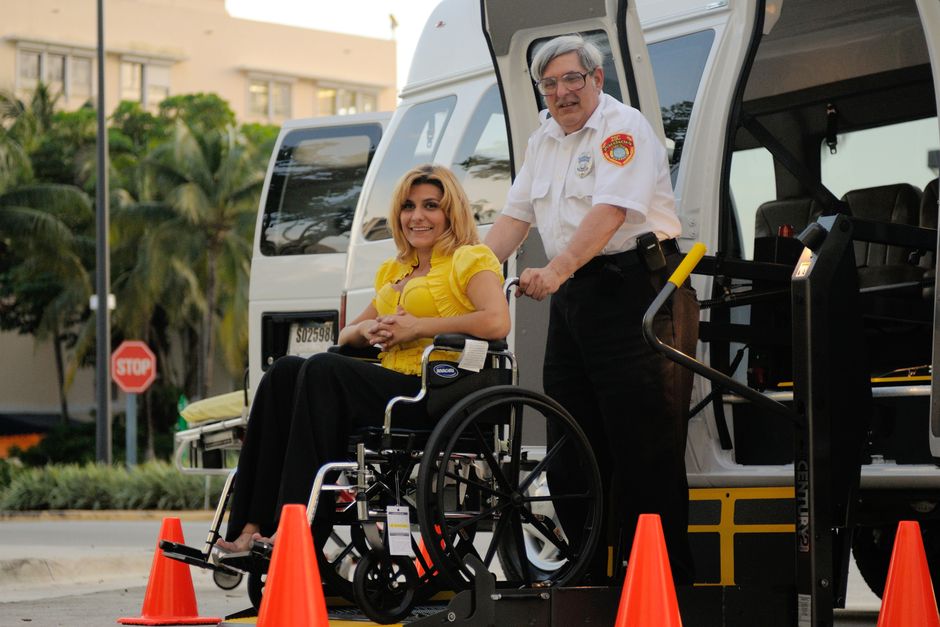
Door-through-door assistance for manual and power wheelchair users heading to specialist appointments, imaging, outpatient procedures, or any non-emergency medical trip where a standard vehicle won't cut it. This is our most-booked service — and the one most families come to us for after a bad experience elsewhere.
Stretcher transport (the one most providers won't do)
For patients who can't safely sit upright for the duration of a ride — post-surgical recovery, bariatric transport, patients with specific positioning requirements. Stretcher trips require 48 hours notice and a two-person crew. Based on our experience, this is where choosing the wrong provider carries the highest patient risk. It's also the service most basic NEMT operators simply don't offer. We've built it as a core capability — not an afterthought.
Hospital discharge transportation
We coordinate directly with nursing staff before we arrive. That pre-arrival call — confirming patient readiness, IV removal status, mobility requirements — is what dropped our average discharge wait time from 47 minutes to 8. Studies confirm that discharge delays raise readmission risk significantly,[10] which is why we treat the handoff as a clinical event. Not a pickup.
Standing schedules for dialysis and chemotherapy
There are roughly 560,000 Americans on dialysis[11] and millions more in active cancer treatment.[12] For those patients, transport consistency isn't a preference — it's a clinical need. Our standing schedules sync with machine availability windows and infusion shift rotations. Same driver, same window, every week. That consistency reduces incident risk. It also makes a genuinely hard routine a little easier to endure.
Five-county and regional coverage
We cover Hillsborough, Polk, Manatee, Highlands, and Hardee Counties — including long-haul runs from Avon Park, Sebring, and Wauchula to Tampa specialists. Patients in rural Highlands and Hardee Counties often have no local NEMT options at all. We've built our routing protocols, toll management, and driver fatigue thresholds around those 60–90 mile runs. Regional destinations including Sarasota, The Villages, and Jacksonville are also available.
Tampa General HospitalSt. Joseph's HospitalMoffitt Cancer CenterAdventHealth TampaBayCare facilitiesDaVita & Fresenius clinicsLakeland Regional HealthRegional Medical Center Bayonet Point
See it in action
What does a real wheelchair transport pickup actually look like?
Reading about 4-point securement and door-through-door service helps. Seeing it is better. This video walks through an actual transport — vehicle setup, boarding, securement, and the bedside-to-destination handoff from the patient's perspective.
Booking & costs
How do you book wheelchair transportation in Tampa — step by step?
1
Call 813-924-8156. Have the facility name, appointment time, pickup address, and equipment type ready. We can confirm availability in under three minutes — faster than any online form.
2
Confirm the service type. Wheelchair van, stretcher, or long-distance. Stretcher trips need 48 hours notice. Same-day wheelchair rides are usually available if you call before noon.
3
Check your coverage before assuming anything. WSTS is a private-pay provider and does not bill Florida Medicaid or Medicare. If your plan covers NEMT, that ride is arranged through your plan's transportation broker — call the number on your insurance card. If you're paying privately, we'll quote you a straight rate up front.
4
Confirm the day before. We'll reconfirm pickup time. For hospital discharge trips, we also run our pre-arrival call to the charge nurse — that's what keeps wait times short.
How much does wheelchair transportation cost in Florida?
Private pay local wheelchair trips in Tampa Bay typically run $75–$150 one-way, depending on distance. Stretcher transport costs more — specialized vehicle, two-person crew. Long-haul trips are mileage-based. If you have Florida Medicaid or a Medicare Advantage transportation benefit, check with your plan's broker first — that ride goes through them, not through WSTS.
Does insurance cover NEMT in Florida?
Coverage overview
Coverage type | What it covers | Key condition |
Florida Medicaid | Often full coverage | Transport must be medically necessary; prior auth may apply[1] |
Medicare Advantage (Part C) | Plan-dependent | Many plans include NEMT as a supplemental benefit[14] |
Original Medicare (A&B) | Typically not covered | Emergency ambulance only in most cases[15] |
Private pay | Always available | $75–$150 local wheelchair; stretcher and long-haul priced separately |
The Medicaid insight no other NEMT guide will tell you
The most common reason a Medicaid trip gets denied isn't patient ineligibility — it's missing documentation of medical necessity. If your physician hasn't included transport necessity language in the referral or discharge paperwork, call the prescribing provider and ask them to add it before you book. That one step prevents the majority of coverage denials.
Related reading from our operation:
Common questions
Frequently asked questions about wheelchair transportation in Tampa
How do I book wheelchair transportation in Tampa for a medical appointment?
Call 813-924-8156 directly. Have the facility name, appointment time, pickup address, and wheelchair type ready. Routine trips: 24–48 hours notice. Stretcher transport: at least 48 hours. Same-day wheelchair rides are usually available if you call before noon — just don't wait until the afternoon before.
How much does wheelchair transportation cost in Florida?
Local one-way wheelchair trips in Tampa Bay typically run $75–$150 private pay, depending on distance. Stretcher transport costs more. WSTS does not bill Medicaid or Medicare — if your plan includes a transportation benefit, arrange that ride through your plan's broker.
Do you provide hospital discharge transportation from Tampa General Hospital?
Yes — and it's one of our deepest specializations. We developed our bedside-to-destination handoff protocol working directly with TGH, St. Joseph's, and Moffitt discharge coordinators. That protocol dropped our average discharge wait time from 47 minutes to 8. Call as soon as discharge is planned; same-day pickups are possible with enough notice.
Is medical transportation covered by Medicare or Medicaid in Florida?
Florida Medicaid often provides full coverage when transport is medically necessary and properly documented.[1] Original Medicare (A&B) typically doesn't cover routine NEMT.[15] Many Medicare Advantage plans do. WSTS is private-pay and does not bill any of these — if you have coverage, contact your plan's transportation broker to use it.
What areas do you serve beyond Tampa?
All of Hillsborough, Polk, Manatee, Highlands, and Hardee Counties, plus Sarasota, The Villages, and Jacksonville for longer trips. Rural patients in Highlands and Hardee Counties traveling to Tampa specialists are some of the people we serve most consistently — there's almost no other NEMT coverage out there for those runs.
How do I verify this is a legitimate, vetted NEMT provider?
State NEMT certification, PMP-certified operator with 1,000+ transports, active membership in the Hillsborough Black Chamber of Commerce and the Upper Tampa Bay Chamber of Commerce, and a Voyage Tampa community feature. All independently verifiable. Go check.
The bigger picture
The ride is part of the care. It always has been.
When the transport works, treatments go as planned, families breathe easier, and patients show up with enough energy left to actually benefit from the appointment they traveled for. After 1,000+ transports across Tampa Bay, I can tell you: the rides that went well weren't accidents. They were planned — with documented protocols, verified coverage, and a driver who knew exactly where to go before leaving the garage.
Punctuality is patient safety — a late transport can cascade into missed treatment slots with real clinical consequences.
Door-through-door isn't a premium — it's the standard. Anything less transfers risk from the provider to the patient.
Local knowledge matters — 20 years of Tampa Bay facility relationships produce outcomes no national dispatch platform can replicate.
Verify your coverage first — missing medical necessity documentation is the #1 reason Medicaid trips get denied. One call to your prescribing provider prevents it.
Ready to book? Call 813-924-8156 — describe the situation, the facility, the appointment time, the mobility needs. We'll confirm availability, cost, and insurance coverage in under five minutes.
If you have questions about discharge coordination or a complex transport scenario, I'm happy to talk it through — call 813-924-8156.
Sources cited in this article
About the author
MJ
Marqus Willard Johnson, PMP
Certified Project Management Professional & NEMT Operator — Tampa, FL
Marqus Willard Johnson is a PMP-certified healthcare transportation operator who has launched and scaled multiple NEMT businesses to six-figure revenue. He's coordinated 1,000+ patient transports across Tampa Bay, with a focus on hospital discharge logistics, private-pay wheelchair and stretcher transportation, and complex long-distance medical transport. He worked directly with Tampa General Hospital and Moffitt Cancer Center to develop the discharge coordination protocols his operation runs on today, and is the author of Millions from Your Couch — a guide to building a profitable NEMT operation. He's been featured in Voyage Tampa's community highlights as a trusted Tampa Bay business leader.

The funniest part of eggy car is trying to protect the egg on uneven roads. It looks simple at first, but timing really matters.