


Tampa Airport Stretcher Transport: What Airlines Won't Tell You
- Marqus Johnson

- Jan 28
- 8 min read
Updated: Jan 28
Overview:
Tampa airport stretcher transportation bridges the gap between your hospital bed and the aircraft door—providing ground medical transport for patients who can't sit upright during air travel, coordinating with airlines on medical clearance, and navigating TSA screening with specialized equipment. The service costs $250-$450 one-way (vs. $800-$1,500 for ambulances), but requires 48-72 hours advance booking so airlines can process physician medical forms (MEDIF) and brief gate crews on your needs. This guide reveals TPA terminal logistics, TSA medical screening procedures, airline-specific stretcher policies, oxygen requirements, and the 4-6 annual gate denials that happen when families skip proper advance notification—insights only providers with 20+ years of airport coordination can share.
Tampa Airport Stretcher Transportation: What You Need to Know First
Landing at Tampa International Airport after surgery at Moffitt Cancer Center shouldn't turn into a scramble. For stretcher patients flying to or from TPA, it happens all the time—families assume "wheelchair service" covers stretcher transport, then find out at the gate it doesn't.
Tampa airport stretcher transportation provides ground medical transport for patients who cannot sit upright during air travel. Services include airline coordination, TSA medical screening assistance, gate escort, and stretcher loading to your destination hospital or home. Cost ranges $250-$450 one-way depending on origin and distance from TPA. You'll need to book 48-72 hours in advance to allow airline notification and medical clearance processing.
Here's what that actually means: If you're flying into Tampa for treatment at Tampa General Hospital or leaving after cancer care at Moffitt, ground stretcher transport bridges the gap between the aircraft door and your medical facility. The airline gets you to the gate. We get you from curbside to your hospital bed—or from your discharge bed to the departure gate.
The cost difference matters. A ground ambulance from TPA to downtown Tampa hospitals runs $800-$1,500 for a 20-minute trip. Stretcher transport for the same route? $250-$300. You're paying for medical-grade equipment and trained staff, not emergency lights and paramedics you don't need for non-emergency transfer.
Real talk: The 48-72 hour booking window isn't arbitrary. Airlines require advance notification to brief gate crews, arrange boarding assistance, and process your physician's medical clearance form (called a MEDIF). Show up day-of expecting curbside stretcher service, and you're looking at a denied boarding or a $1,200 emergency ambulance bill.
When You Need Stretcher Transport to Tampa International Airport
This service exists for one reason: You're medically stable enough to fly commercial, but you can't sit upright in a standard airplane seat. That's the gap—and it's bigger than most families realize until they're living it.
Post-Surgical Patients Flying Home After Tampa Treatment
You came to Tampa for specialized care. Moffitt Cancer Center treated your cancer. Tampa General performed your transplant. St. Joseph's handled your cardiac procedure. Now you're cleared to fly home, but your surgeon says "no sitting upright for 6-8 weeks."
The discharge planner mentions "medical transport to the airport," and families assume that means wheelchair van service. It doesn't. Stretcher patients need stretcher transport—flat positioning from hospital bed to aircraft boarding, with medical equipment (oxygen, IV poles, wound vacs) secured during the 20-40 minute drive to TPA.
Medical Tourists Arriving for Tampa's Specialized Care
The reverse scenario is just as common. You're flying to Tampa for treatment you can't get locally. Moffitt's proton therapy program. Tampa General's liver transplant team. Shriners Hospital for Children's orthopedic specialists.
Your physician back home cleared you for commercial flight with stretcher accommodation, but nobody explained how you get from Airside C baggage claim to Tampa General's admissions. You need ground stretcher transport coordinated before your flight lands—because showing up at TPA without pre-arranged medical transport means a 2-3 hour wait for emergency ambulance services that insurance may not cover.
Snowbirds With Medical Emergencies Returning North
February in Tampa, heart attack in Clearwater, stabilized at Morton Plant Hospital. You're cleared to fly back to Michigan or Ontario, but you're still on bed rest with supplemental oxygen. Your winter rental lease ended. Your car's already shipped north.
This is where families panic-Google "Tampa airport medical transport" at 11 PM and find out most services need 48 hours' notice. Stretcher transport to TPA for medical evacuation flights requires the same advance coordination as routine transfers—airline notification, oxygen equipment rental, TSA medical screening pre-clearance.
Cruise Ship Medical Evacuations to Tampa International
Port of Tampa is 15 miles from TPA. Cruise lines evacuate 200+ passengers annually for medical emergencies—heart attacks, strokes, falls, appendicitis. The cruise line's shore-side medical coordinator arranges your emergency flight home, but they don't arrange ground transport from port to airport.
You're discharged from Tampa General's ER with "cleared for air travel with medical escort." Your flight to Newark leaves in 6 hours. Port of Tampa to TPA stretcher transport takes 25-30 minutes in normal traffic, but you need TSA medical screening buffer time (3-4 hours pre-flight minimum) plus airline medical clearance processing.
Veterans Flying To or From VA Tampa
James A. Haley Veterans' Hospital on Bruce B. Downs Boulevard serves 200,000+ veterans across West Central Florida. Specialized care—spinal cord injury, polytrauma, blind rehabilitation—often requires veterans to fly in from out of state.
VA benefits cover medically necessary non-emergency transport, but the VA doesn't operate its own airport stretcher service. Veterans approved for VA-funded travel need to arrange contracted stretcher transport that accepts VA authorization. Not all Tampa medical transport companies are VA-approved vendors, which is where families hit a wall 24 hours before a scheduled flight.
International Patients at Tampa Specialty Facilities
Johns Hopkins All Children's Hospital in St. Petersburg treats international pediatric patients. Shriners Hospitals for Children in Tampa serves kids from Latin America and the Caribbean. These families fly into TPA, often for multi-week treatment stays, then fly home with medical equipment and post-surgical positioning restrictions.
International arrivals need stretcher transport that coordinates with U.S. Customs wheelchair assistance at TPA. Gate-to-baggage-claim escort for stretcher patients clearing customs takes 45-60 minutes longer than standard wheelchair assistance—timing your ground transport pickup requires knowing which Airside and carousel your international flight uses.
The Complete Process: Booking to Boarding
Here's what actually happens when you book Tampa airport stretcher transportation, broken into the timeline airlines and TSA require.
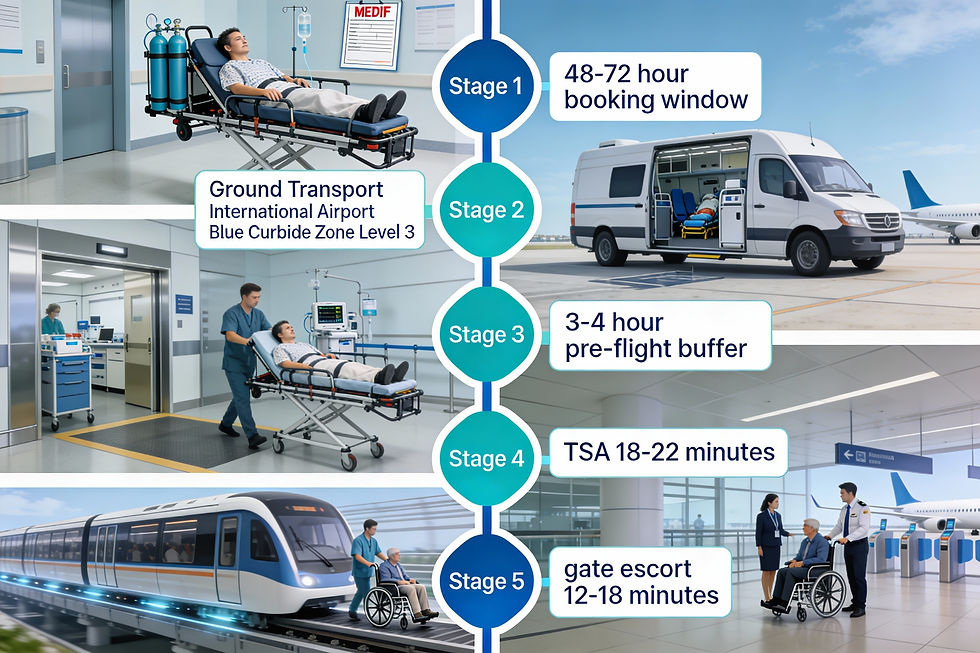
48-72 Hours Before Your Flight: The Booking Window That Matters
Call to book: 813-924-8156. You'll need your flight details (airline, flight number, departure time), pickup location (which Tampa hospital or home address), and basic medical info (oxygen requirements, IV access, catheter, weight for bariatric stretcher needs).
Why 48-72 hours? Two reasons families underestimate: First, airlines require advance notification that a stretcher patient is traveling. Gate crews need to know you're arriving curbside via stretcher so they can arrange wheelchair-accessible boarding (jetway ramp positioning, aisle chair staging, ground crew coordination). Second, most airlines require a physician-completed MEDIF form (Medical Information Form) submitted 48 hours before departure.
Your transport provider can walk you through the MEDIF process—it's a 2-page PDF your discharging physician faxes to the airline's medical clearance department. Without the MEDIF processed and approved, you're denied boarding even if you're curbside at the gate with a stretcher. This is where families trying to book 24 hours out hit a wall.
Oxygen equipment coordination happens now. If you need supplemental oxygen during transport and during flight, confirm: (1) Ground transport provides oxygen during the van ride to TPA, and (2) You've arranged an FAA-approved portable oxygen concentrator for in-flight use. Airlines do NOT provide medical oxygen. The concentrator you used in the hospital? Probably not FAA-approved. This catches families off-guard every week.
24 Hours Before Departure: Confirmation and Final Details
Expect a confirmation call reviewing pickup time, equipment needs, and airline status. For stretcher patients, pickup time is 3-4 hours before departure versus the standard 2-hour recommendation.
Here's why: TSA medical screening for stretcher patients with oxygen tanks, IV poles, or wound vacs takes 15-20 minutes versus 5 minutes for PreCheck passengers. Add 10 minutes for medical equipment hand-inspection. Add another 15-20 minutes for gate escort from security checkpoint to your departure gate (TPA's Air sides A, C, E, and F require automated people mover transfer—stretcher patients use the elevator to the monorail platform, then elevator down to the Airside).
You need 90 minutes minimum from curbside arrival to gate arrival. Add your airline's check-in and boarding cutoff times (usually 45-60 minutes pre-departure), and you're looking at 3+ hours total buffer.
Equipment verification matters here. Confirm your stretcher positioning restrictions with your physician. Flat-only? Can you tolerate 15-20 degrees elevation during van transport? Can you sit semi-reclined for transfer to the aircraft aisle chair, or do you need a specialized stretcher-to-seat transfer device? Gate crews need this information before you arrive—it determines whether you board first (before all other passengers) or last (after everyone's seated).
Day of Transport: From Door to Departure Gate
Your driver arrives at your hospital or home with a medical-grade stretcher (Stryker Power-PRO XT, bariatric-rated to 750 lbs), oxygen equipment if needed, and a two-person crew for patients over 400 lbs or requiring lift assistance.
The transfer from bed to stretcher happens inside your room or home—not in the driveway, not in the hospital lobby. For hospital discharges, your nurse completes the final vitals check and hands off discharge paperwork and medications. For home pickups, families often ask: "Do we need to move furniture?" Yes—clear a path from the bedroom to the front door wide enough for a stretcher (36 inches minimum). Tight corners and narrow hallways slow transfers and cut into your TPA arrival buffer time.
Drive time to TPA from major Tampa hospitals:
Moffitt Cancer Center (McKinley Drive): 20-25 minutes in normal traffic, 35-40 during weekday morning rush (7-9 AM)
Tampa General Hospital (Davis Islands): 18-22 minutes
St. Joseph's Hospital (MLK Blvd): 20-25 minutes
VA Tampa (Bruce B. Downs): 25-30 minutes
St. Pete hospitals (Johns Hopkins All Children's, Bayfront): 35-45 minutes via I-275
TPA arrival and curbside drop-off: Main Terminal, Blue Curbside Zone, Level 3 Departures. This is the designated medical passenger drop-off area—15-minute parking limit versus 5 minutes for standard drop-offs. Your driver pulls up to the curbside wheelchair assistance podium, notifies the airline wheelchair coordinator that a stretcher patient has arrived, and waits with you until the airline's ground crew brings a stretcher-compatible wheelchair (usually an oversized transport wheelchair or aisle chair depending on your positioning needs).
TSA medical screening checkpoint: TPA's main security checkpoint (between the ticket counters and the Airside transfer area) has a dedicated medical screening lane on the right side. Your driver escorts you to the TSA checkpoint, hands off to the airline's wheelchair escort, and provides any equipment that needs hand-inspection (oxygen tanks, medical devices, medications).
Here's what TSA does with stretcher patients: You'll transfer to a TSA-provided wheelchair for the metal detector (if you can tolerate sitting) or receive a full-body pat-down inspection on your stretcher (if you cannot sit). Medical equipment gets hand-swabbed for explosives residue. Oxygen tanks get X-rayed separately. IV bags and liquid medications over 3.4 oz are allowed but require separate screening. Budget 15-20 minutes total.
Gate escort to your departure Airside: After TSA clearance, the airline wheelchair assistant takes you to the automated people mover (the monorail-style train connecting the Main Terminal to Airsides A, C, E, and F). Stretcher patients use the elevator to the platform level, board the people mover in the wheelchair-accessible car, then take another elevator down to the Airside gate level. Total time: 10-12 minutes depending on which Airside and how long you wait for the next train.
At the departure gate: You'll wait in the designated wheelchair/medical assistance area near the gate podium. Boarding procedures vary by airline—Southwest typically boards stretcher patients first (before Family Boarding), Delta and United board last (after all other passengers are seated). Your wheelchair escort coordinates with the gate agent and ground crew for jetway positioning and aisle chair transfer if you're flying on an aircraft with a narrow aisle.
After Landing: Baggage Claim to Destination
If you're arriving at TPA (flying in for Tampa medical treatment), your ground stretcher transport meets you at baggage claim after you clear the arrival gates. The airline wheelchair escort brings you from the aircraft door, through the Airside, down the people mover, and to the Main Terminal Level 1 baggage claim area.
Your transport driver monitors your flight in real-time—if your flight from Atlanta is delayed 90 minutes, the driver adjusts pickup time automatically. No extra charges for flight delays (most transport companies charge wait time fees; this is where you need to confirm policies when booking).
Baggage claim assistance: Your driver retrieves checked luggage while you wait in the stretcher or transport wheelchair. Medical equipment (portable oxygen concentrators, CPAP machines, mobility devices) is tagged priority baggage and comes out first.
From baggage claim to your Tampa hospital or home: Same vehicle, same crew, reverse process. If you're checking into Moffitt Cancer Center for scheduled treatment, the driver coordinates with Moffitt's admissions to ensure your room assignment is ready before arrival (Moffitt has specific procedures for incoming stretcher patients—direct-to-room escort versus waiting in the lobby).
Related Articles:


Comments