


My Aunt Was Stuck in a Tampa General Discharge Bay for 4 Hours — Here's What I Wish Someone Had Told Us
- Marqus Johnson

- Mar 30
- 9 min read

Overview:
Most Tampa Bay families don't know non-emergency wheelchair transport exists until they're already in a hospital discharge bay, panicking and assuming "medical transport" means ambulance money. This guide breaks down real 2026 pricing by hospital and route, explains what insurance covers, and gives you a three-step plan you can use for any scheduled discharge in Hillsborough County.
It was a Tuesday in the middle of October. My aunt had just come through a hip replacement at Tampa General Hospital — surgery went well, recovery was on track, and the discharge nurse told us she'd be ready to go by 11 a.m.
My cousin was in the waiting room at 10:45. He was ready. He had the car. What he hadn't thought about — what none of us had — was that my aunt couldn't bend her hip past 90 degrees post-surgery and couldn't physically lower herself into a standard sedan. She needed a wheelchair van with a hydraulic lift.
So the scramble began. My cousin called me. I called my brother. Someone Googled "medical transport Tampa" and saw the word ambulance and assumed that meant $1,500 minimum. We assumed they were the same thing. We were wrong — but we didn't know that yet.
My aunt sat in the discharge bay for four hours.
"She was in a wheelchair in a hospital hallway, post-surgery, waiting for us to figure out something a single phone call would have solved. That was the moment I decided I was going to learn everything about how this works — so no one else's family goes through the same thing."
The punchline? The ride cost $75. Door-through-door, from her discharge room to her house in South Tampa, in a clean wheelchair-accessible van with a trained driver who knew exactly where TGH's patient pickup dock was. Forty-five minutes from booking to arrival. We just didn't know it existed.
Why This Happens to Almost Every Family
Here's the thing — you are not alone in this. What happened to my aunt's family happens in Tampa Bay hospitals every single day, across thousands of wheelchair discharges every year. It's not a failure of love or planning. It's a failure of information.
Hospitals are extraordinarily thorough about discharge planning. They coordinate follow-up appointments, medication schedules, home health aide visits, physical therapy referrals. What they rarely do is hand you the name and number of a wheelchair transport provider. They assume you have a ride — and they define "ride" as any car that pulls up to the curb.
Families, meanwhile, hear "medical transport" and picture an ambulance. The mental math happens instantly: lights, sirens, EMTs, $2,000. That assumption kills the conversation before it starts. Nobody calls. Nobody asks. And the patient waits.
The information gap
The discharge planner coordinates your meds, your follow-ups, your home health. They almost never arrange the ride. That gap — between "medically cleared" and "actually home safe" — is exactly where families get stuck.
The cruel irony is that the people who need this information most are the people least equipped to search for it: they're exhausted, emotionally spent, operating on hospital-cafeteria coffee, trying to keep a loved one comfortable and calm in a busy discharge area. Googling "wheelchair transport near me" at that moment is the last thing on anyone's mind.
What NEMT Actually Is — And What It Isn't
Non-Emergency Medical Transportation (NEMT) is a licensed, scheduled transport service for patients who need more than a regular car but don't need an ambulance. In plain terms: it's a professional wheelchair van service, operated by trained drivers, fully insured, and regulated by the Florida Agency for Health Care Administration (AHCA).
This is not an Uber with a ramp. AHCA licensing requires vehicle inspections, background-checked drivers, CPR and passenger assistance training, and ADA-compliant securement equipment. Every legitimate NEMT provider in Florida has a license number — and if they can't produce one, you walk away.
NEMT vs. Ambulance — The Number That Changes Everything
Cost comparison · 2026 Tampa Bay
Ambulance (emergency): $1,200–$2,500+ · Emergency medical staff, lights, sirens — for life-threatening situations only.
NEMT wheelchair transport: $75–$150 one-way · Scheduled, non-emergency, door-through-door — for post-surgery, dialysis, cancer treatment, nursing home transfers.
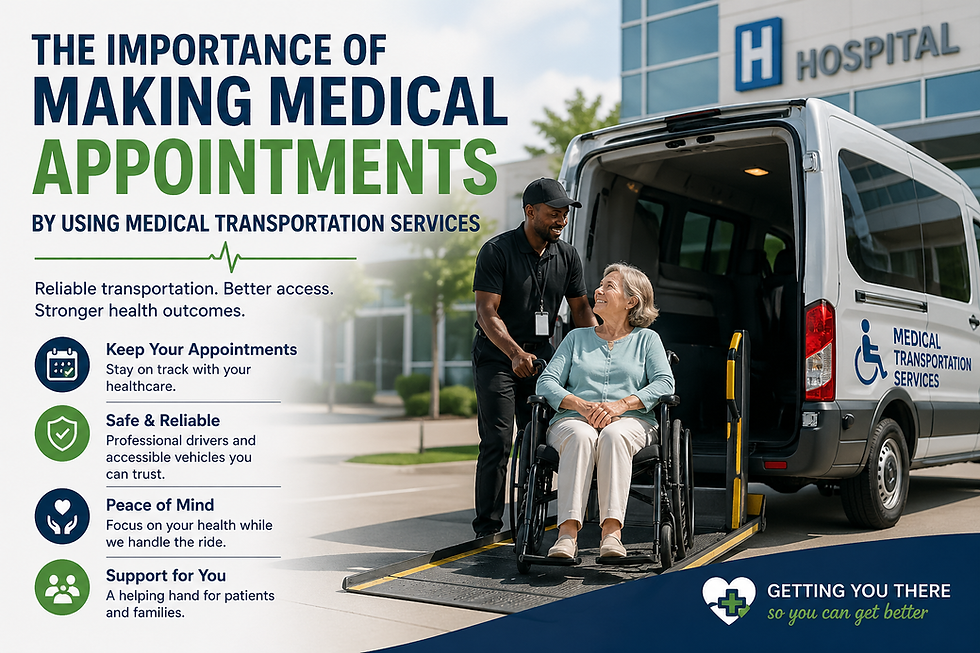
Wheelchair NEMT vehicles are purpose-built: hydraulic lift or ramp entry, four-point tie-down securement for the wheelchair (your family member stays seated in their chair the entire ride — no transfers, no repositioning), climate control, and enough interior height to move comfortably. For stretcher transport — patients who must remain lying flat after surgery or during treatment — the same licensed framework applies, with a gurney-equipped van instead.

What affects the price: driving distance, power wheelchair vs. manual (power chairs weigh more and require more securement time), bariatric needs, stair assistance at home, oxygen equipment, and excessive wait time beyond the standard 90-minute hospital buffer.
What you should never be charged for
Normal hospital discharge delays up to 90 minutes — hospitals run late, always. Weekend or holiday surcharges on a quoted price. Last-minute rush fees when same-day service is the standard offering. Any provider who adds these after the fact is not operating professionally.
Does Insurance Cover It? Probably Yes — Here's How to Check
Florida Medicaid covers the full cost of wheelchair NEMT when transportation is medically necessary. For most Medicaid-eligible patients in Tampa Bay, the ride is $0. The key phrase on the discharge paperwork is "medically necessary non-emergency transportation" — your discharge planner can add this language.
Medicare Advantage plans — the private Medicare plans sold by Humana, UnitedHealthcare, Aetna, and others — frequently include NEMT as a covered benefit. Original Medicare (Parts A and B) typically does not. If your family member has a Medicare Advantage plan, call the member services number on the back of their card and ask specifically about non-emergency wheelchair transportation benefits.
Private insurance coverage varies, but a doctor's discharge order or a letter of medical necessity is usually sufficient to trigger reimbursement. Ask the NEMT provider to give you an itemized receipt — you'll need it for the claim.
The Medicaid Loophole Most Tampa Families Miss
Many patients 65 and older, or on long-term disability, qualify for Medicaid and don't know it — especially when they're also on Medicare. This dual-eligibility scenario is more common than families expect, and it means the ride is fully covered. Ask the hospital's social worker to run an eligibility check before you assume it's private pay.
Three-step insurance check
1. Tell your discharge planner you need wheelchair transport and give them the patient's insurance cards.
2. Call the NEMT provider — they verify coverage in minutes, not hours.
3. If coverage is confirmed, you may pay nothing. If not, you have a clear private-pay quote before you commit.
The 3-Step Plan So This Never Happens to Your Family
1
Before admission — or as soon as surgery is scheduledAsk the hospital's discharge planner about transportation. Use the words "wheelchair transport" — not "ambulance," not "medical transport." Save the number for a local licensed NEMT provider in your phone before you ever need it. This conversation takes three minutes and eliminates every scenario in this article.
24–48 hours before discharge Call the NEMT provider with four pieces of information: hospital name, approximate discharge time, destination address, and insurance details. Get a confirmed written quote. Same-day booking is available if you call before noon — but planning ahead means zero day-of stress, regardless of what the hospital's schedule does.
3
Discharge day — your only job is the personThe driver arrives early, checks in with the nursing station, and meets the patient at the discharge area or their room. The wheelchair is secured with four-point tie-downs. The ride is direct and door-through-door. You follow in your car, or you ride along — there's always room for a companion. Your only job that day is being present for your family member, not managing logistics.
What "Door-Through-Door" Actually Means
The transportation industry uses a lot of terms that sound similar but mean very different things for post-surgical patients. Understanding the difference matters.
Curb-to-curb means the vehicle pulls up outside and you get yourself in and out. Not appropriate for someone who just had hip surgery.
Door-to-door means the driver drops you at the front entrance and leaves. Better — but a post-surgical patient still has to navigate from the door to wherever they're going inside.
Door-through-door is the standard for professional NEMT: the driver enters the facility, finds the patient, assists them from the discharge area into the van, secures the wheelchair, drives to the destination, and assists the patient inside their home or receiving facility. They know where Tampa General's discharge dock is. They know Moffitt's patient pickup loop. They know which entrance at St. Joseph's avoids the parking structure maze. This is not accidental knowledge — it's the job.
For patients who are on pain medication post-surgery, who have wound drains or IVs still in place, or who are simply frightened and disoriented after days in the hospital, this level of attention is not a luxury. It's what separates professional medical transport from a rideshare with a lift.
Red Flags — How to Spot a Bad NEMT Provider
Not every company that shows up on a Google search for "wheelchair transport Tampa" is operating at the same standard. Before you book, look for these warning signs:
Charges wait-time fees after only 30 minutes — hospital discharges are never on time, and 90 minutes of buffer should be standard
Full no-show fees when discharge is delayed by the hospital, not the family
Weekend or holiday surcharges added after the initial quote
No AHCA license number visible on their website or on the vehicle itself
Refuses to give a firm quote until after the trip is completed
No experience with your specific hospital — they should know the facility by name and know the pickup protocol
Drivers who are unfamiliar with four-point wheelchair securement or who ask the patient to transfer out of their chair
A legitimate, licensed NEMT provider in Florida will give you a confirmed quote upfront, verify insurance before the trip, and hold to the price they quoted. If a provider is vague about any of this, keep calling.
Frequently Asked Questions
How far in advance do I need to book wheelchair discharge transport?
Same-day service is available when you call before noon, but 24–48 hours ahead is always ideal. Booking in advance locks your time slot and gives the driver time to confirm hospital pickup protocols before the day arrives.
Can the driver help with stairs at home?
Yes — stair assistance is available as a booked add-on for approximately $25 and must be requested at the time of booking, not on the day of the trip. If your home has stairs, mention it when you call.
What if my family member uses a power wheelchair?
Power wheelchairs and scooters are secured inside the van using a four-point tie-down system. No folding, no transferring, no repositioning. The patient stays in their chair the entire ride — including during loading and unloading.
What if the hospital delays discharge by 2+ hours?
A professional NEMT provider builds buffer time into every hospital pickup and will never penalize you for standard hospital delays. If you anticipate a significant delay, call the provider and let them know — they'll adjust without a fee.
Is this covered by Medicare?
Original Medicare (Parts A and B) typically does not cover NEMT. However, many Medicare Advantage plans include it as a standard benefit. Florida Medicaid covers NEMT in full for eligible patients. Call us and we'll verify your coverage before you commit to anything.
What's the difference between NEMT and an ambulance?
An ambulance is for life-threatening emergencies — staffed by EMTs, equipped for on-scene medical intervention, and priced accordingly at $1,200–$2,500+. NEMT is scheduled, non-emergency wheelchair transport for patients who need a safe, accessible ride — not emergency medical care. In Tampa Bay, that ride typically costs $75–$150.
Do you serve hospitals outside Hillsborough County?
Yes — we serve Pinellas, Pasco, Manatee, and Polk Counties, and we handle long-distance Florida routes for patients transferring between facilities. Call us with the origin and destination and we'll give you an exact quote.
Don't Let Your Family Sit in a Discharge Bay
My aunt sat in that discharge bay for four hours because no one in our family knew that what she needed had a name, a price tag, and a phone number. We weren't negligent. We weren't unprepared in any other way. We just didn't know this existed.
The real cost of that afternoon wasn't $75. It was four hours of a post-surgical patient sitting in a hospital hallway, increasingly uncomfortable, surrounded by the guilt of a family that genuinely didn't know what to do. That's the cost nobody quotes you.
You're reading this, which means you already know more than we did that day. One phone call, one quote, one confirmed booking — and the hardest part of discharge day becomes the easiest.
Get Your Free Exact Quote — Right Now
Tell us the hospital, the date, and where you're headed. We'll give you a firm price, verify your insurance, and confirm your booking — in one call.
Call to BookRequest a Quote Online
Same-day service available · Insurance verification included · Serving all Tampa Bay hospitals
MJ
Marqus Johnson
Founder, Wheelchair & Stretcher Transportation Services · Tampa, FL
Marqus Johnson founded Wheelchair & Stretcher Transportation Services after 15 years in the medical transportation industry. A licensed NEMT operator and PMP-certified professional, he is a member of the Upper Tampa Bay Chamber of Commerce and a recognized voice in accessible healthcare logistics across the southeastern United States.
Related Post:
How to Arrange Stretcher Transportation for Hospital Discharge in Florida — directly relates to post-hospital transport, which ties into the discharge and stretcher sections of your guide.
The Complete Guide to Safe Wheelchair Transport in Florida: Rates, Booking, and Local Expertise — your comprehensive statewide guide that covers rates and booking, a natural "learn more" link from the localized Brandon/Riverview/Sun City Center article.
What Caregivers Should Know About Senior Transportation Services — AARP — trusted resource for your target audience (family caregivers) that reinforces the importance of safe medical transport for seniors.
Non-Emergency Medical Transportation — CMS/Medicare — authoritative government source covering Medicaid/Medicare NEMT benefits, which supports your insurance and coverage sections.


幫朋友挑選中文名字時找到這個 起名網,網站提供的名字解析很容易理解,對於不了解傳統取名方式的人也很友善。