


Medical Wheelchair Transportation in Tampa Bay: How Patients Get to Critical Care Safely When Family or Ride-share Is Not Enough
- Marqus Johnson

- Apr 30, 2023
- 5 min read
Updated: Apr 30

For many families, the medical appointment is not the hardest part.
Getting the patient there safely is.
After coordinating 1,000+ patient transports across Tampa Bay, I can tell you this without hesitation: missed dialysis visits, delayed oncology treatments, and prolonged hospital discharges often happen because there was no medically appropriate transportation plan in place.
That sounds minor until you see the real fallout:
delayed physician follow-ups,
increased caregiver stress,
rescheduled treatments,
patients sitting in discharge longer than necessary,
and medically fragile seniors being moved in vehicles that were never appropriate in the first place.
This is why Non-Emergency Medical Transportation (NEMT) has become a critical part of healthcare continuity—not just a convenience ride.
According to the Centers for Disease Control and Prevention, transportation barriers remain one of the major social factors affecting whether patients consistently access needed medical care.
That means transportation is no longer separate from healthcare.
It is attached to the outcome.
Why Does Reliable Medical Wheelchair Transportation Matter So Much in Tampa Bay?
Because Tampa Bay has a growing senior population, a heavy concentration of specialty hospitals, and thousands of patients who physically cannot use ordinary transportation options.
Wheelchair-bound patients, post-operative orthopedic patients, dialysis patients, and oncology patients often need recurring appointments that cannot be missed.
And yet families still make the same mistake:
they assume a family sedan, a friend, or a rideshare will “figure it out.”
Usually, it doesn’t.
In our Tampa Bay dispatch system, the most common transport failures happen when:
family vehicles are not wheelchair accessible,
elderly spouses cannot physically assist loading,
rideshare drivers refuse medical equipment,
discharge planners wait until the last minute,
patients are too weak to sit upright after treatment.
I have seen this repeatedly while scaling multiple NEMT operations into six-figure healthcare transport systems.
The transport issue quietly becomes the medical issue.
Who Is Behind This Tampa Bay Medical Transportation Operation?
My name is Marqus Willard Johnson, PMP, and I built this company after seeing firsthand how fragmented non-emergency transport was for medically vulnerable patients across Hillsborough County.
As highlighted in Voyage Tampa’s feature on our business journey, this operation was never designed to be just another wheelchair van with a phone number attached.
The mission was straightforward:
build a private-pay transportation system families, discharge planners, case managers, and rehab facilities could actually depend on when ordinary transportation options failed.
Since launch, my team and I have coordinated:
Tampa General Hospital discharge transfers,
Moffitt Cancer Center oncology rides,
dialysis recurring appointment runs,
long-distance specialty care transport,
oxygen-supported wheelchair transfers,
assisted living and rehab moves.
Healthcare transportation looks simple from the outside.
It is not.
When a patient’s health depends on arrival, “just send a driver” is amateur thinking.
What Makes Professional Non-Emergency Medical Transportation (NEMT) Different From Uber or Standard Ride Services?
A normal ride service solves one problem:
movement.
A professional Non-Emergency Medical Transportation (NEMT) provider solves five problems at once:
Safe loading
Medical punctuality
Wheelchair securement
Physical comfort
Caregiver or facility communication
That is a completely different operation.
As featured through our verified professional profiles and healthcare transportation resources on LinkedIn, our company uses process-driven scheduling rather than random dispatching.
That means every trip begins with actual intake verification:
wheelchair dimensions,
transfer assistance level,
oxygen need,
pickup contact,
discharge readiness,
appointment arrival deadline.
Then route timing is buffered around:
elevator delays,
facility release lag,
caregiver handoff,
loading time,
unloading time.
This is where my PMP certification matters.
Healthcare transportation that scales safely cannot run on habits.
It must run on systems.
Which Tampa Bay Hospitals Commonly Require Wheelchair Transport Coordination?
Our highest recurring transport demand consistently comes from:
Tampa General Hospital discharge transfers
Moffitt Cancer Center oncology appointments
outpatient surgery centers
dialysis clinics
rehab and skilled nursing facilities throughout Tampa Bay
One practical truth families learn too late:
waiting until discharge day to arrange transportation usually creates the discharge delay.
Honestly, this is one of the biggest hidden problems in healthcare transport.
Hospitals can medically clear the patient.
That does not magically create a safe ride home.
In our own operations, pre-scheduled trips consistently perform better than same-day scramble bookings because the handoff details are already controlled.
That means:
fewer missed ETA windows,
less caregiver confusion,
less patient waiting,
smoother case manager coordination.
This is why we routinely tell discharge planners to confirm transport at the same time discharge begins—not after the wheelchair is already at bedside.
How Does Our Tampa Bay NEMT Service Compare to Typical Alternatives?
Factor | Our Approach | Typical Alternative | Patient Impact |
Scheduling | 24/7 pre-book phone coordination | Limited office-hour response | Faster discharge setup |
Vehicle Type | Wheelchair + stretcher capable units | Wheelchair only or non-medical vans | Correct transport level |
Coordination | Direct caregiver/facility communication | Patient manages details alone | Reduced confusion |
Intake Process | Medical verification before dispatch | Minimal trip details collected | Lower trip failure risk |
Patient Assistance | Door-through-door loading support | Curbside only | Safer transfers |
Specialty Trips | Long-distance + complex transport | Often local-only | Better access to care |
This is not marketing fluff.
This is operational difference.
And operational difference is what patients feel on trip day.
How Can Families Verify That a Tampa Bay Medical Transportation Company Is Legitimate?
Do not trust any provider based on a website headline alone.
Check for public trust indicators.
Our company maintains active professional involvement through the Hillsborough County Black Chamber of Commerce, reinforcing local accountability and business visibility.
Our business credentials are also publicly listed through the Upper Tampa Bay Chamber of Commerce, giving families and healthcare providers an additional verification point that they are dealing with an established Tampa Bay operator.
That matters.
Because many so-called “medical transport” listings online are little more than an unverified cellphone number.
Professional affiliations separate real operators from improvised side hustles.
Want to See the Medical Wheelchair Transportation Process Before Booking?
You should.
Families should never book healthcare transport blind.
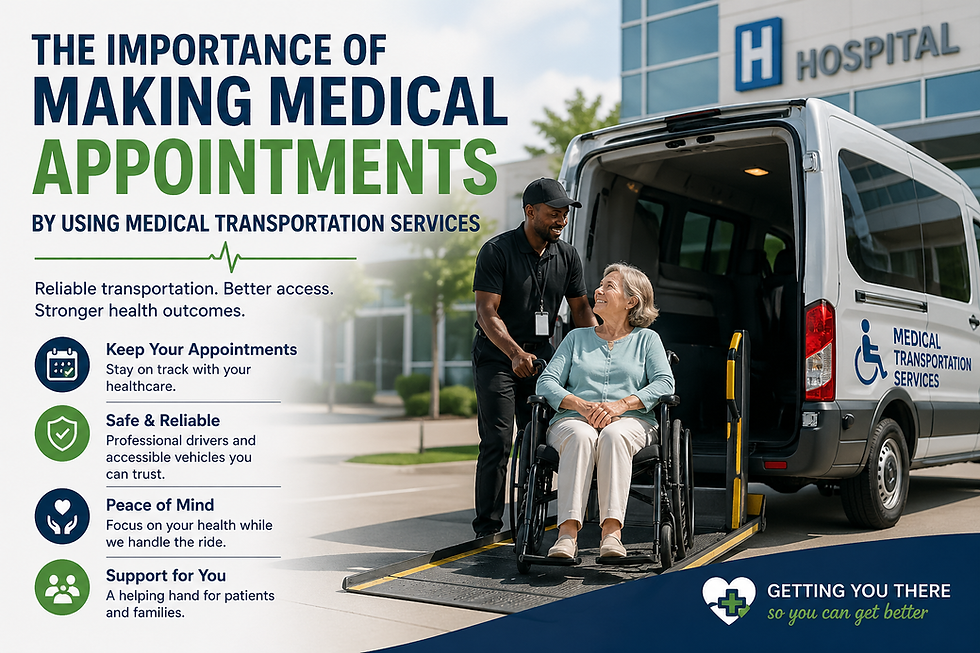
That is why we publicly show our vehicle setup, wheelchair loading standards, and patient handling workflow through our active YouTube demonstration video.
Seeing the process removes a lot of uncertainty:
Is the van clean?
Is the wheelchair secured properly?
Does the crew look trained?
Does this feel professional?
Visual proof answers what sales copy cannot.
What Is the Biggest Medical Transportation Mistake Families Make?
Treating transportation like an afterthought.
This happens every day.
The doctor appointment gets scheduled.The surgery gets scheduled.The discharge gets approved.
And transportation gets handled the morning of.
That is backwards.
After more than 1,000 completed Tampa Bay patient transports, my opinion is simple:
the best patient outcomes happen when transportation is booked at the same time medical care is booked.
Not later.
Not “we’ll call around tomorrow.”
Transportation should be part of the care plan itself.
That single shift prevents a huge amount of avoidable stress.
Need Safe Non-Emergency Medical Transportation (NEMT) in Tampa Bay?
We provide:
private-pay wheelchair transportation,
stretcher transportation,
hospital discharge logistics,
dialysis transport,
oncology transport,
long-distance medical appointments,
assisted living and rehab transfers.
Serving all of Tampa Bay including:
Tampa
Brandon
Riverview
Sun City Center
Apollo Beach
Valrico
Call 813-924-8156 to pre-schedule transport
Visit www.wheelchair-tampa.com
Helpful Tampa Bay resources:
Internal Link: Hospital Discharge Transportation Tampa Guide
Internal Link: Private Stretcher Transportation in Florida
Internal Link: How to Prepare an Elderly Parent for Wheelchair Medical Transport
About the Author
Marqus Willard Johnson, PMP is a certified Project Management Professional, healthcare transportation operator, and founder of multiple six-figure Non-Emergency Medical Transportation (NEMT) businesses. Since 2021, he has coordinated more than 1,000 patient transports across Tampa Bay specializing in hospital discharge logistics, private-pay wheelchair and stretcher transportation, and complex long-distance medical routing.
He has worked directly around discharge workflows tied to facilities including Tampa General Hospital and Moffitt Cancer Center, helping reduce avoidable delays, improve scheduling reliability, and create safer patient handoff systems.
Professional Profile: Connect with Marqus Johnson on LinkedIn
Other Related Articles by Marqus:
Wheelchair Transportation Costs in Tampa: 2025 Rates & Coverage
Confirm Wheelchair Transport 48–72 Hours in Advance for Safer Discharges
Non-Emergency Stretcher Transportation: A Safe Alternative to Ambulances
Medical Disclaimer
This company provides non-emergency medical transportation only. For any medical emergency, call 911 immediately.


Comments