


Stretcher Transportation in Brandon FL: What to Expect & How to Book Same-Day Service

Introduction
You just got the call. The doctor says your loved one can be discharged today — but they can't sit up. Not for a car ride, not for a wheelchair van, not for anything. And now you're standing in the hallway at HCA Florida Brandon Hospital trying to figure out what happens next.
That moment is exactly what this guide is for.
Stretcher Transportation in Brandon FL: What to Expect & How to Book Same-Day Service is a question most families have never had to answer before — until they're already in the middle of it. This article covers everything you won't find in one place anywhere else: what the ride actually looks like from start to finish, how to know if your loved one truly needs a stretcher versus a wheelchair van, what same-day non-emergency stretcher transport in Brandon costs and how availability works, and how to prepare your home before the crew arrives.
By the time you finish reading, you'll know exactly what to say when you call, what to expect at pickup, and how to avoid the booking mistakes that leave patients stranded at discharge. No guesswork. No surprises.
⚡ Quick Answer: What Is Stretcher Transportation in Brandon, FL?
Stretcher transportation in Brandon, FL is non-emergency medical transport for patients who cannot sit upright. A trained two-person crew arrives at your location — hospital room, home, or facility — transfers the patient onto a medical gurney, and delivers them bed-to-bed. Same-day service is available; call before noon for best availability. For urgent requests, always call (813) 924-8156 directly — do not rely on online booking.
What Is Stretcher Transportation — and Do You Actually Need It?
Stretcher transport is not an ambulance. It's not a wheelchair van. It sits in a specific middle ground that most families don't know exists — until they're standing at a hospital discharge desk asking nurses what their options are.
Here's the clinical definition: stretcher transport is for patients who are medically stable but physically can't maintain an upright seated position for the duration of a trip. The vehicle is a specialized gurney van — not a standard accessible vehicle — equipped with a mounted, secured stretcher, hydraulic loading lift, and a two-person crew trained in safe patient transfer.
Stretcher vs. Wheelchair vs. Ambulance — Which One Does Your Loved One Need?
Getting this wrong has real consequences, so let's be precise.
Ambulance: For medical emergencies — active crises, life-threatening conditions requiring on-board paramedic intervention. If the situation is urgent, call 911, not us.
Wheelchair van: For patients who can sit upright safely for the full ride, with or without mobility assistance.
Stretcher transport: For patients who can't sit up — full stop. That includes anyone with a clinical supine order, those recovering from spinal or abdominal surgery, dialysis patients who can't tolerate an upright position post-treatment, and anyone moving directly from one bed to another with no seated phase in between.
The one question worth asking before you call: Find the nurse or discharge coordinator and say, "Does the patient have a supine order, or can they safely sit for the trip?" That single answer tells you exactly which vehicle to book. Supine order? Stretcher transport. Can sit safely? A wheelchair van works — and it'll cost less.
Booking the wrong type isn't just inconvenient. A driver arriving with a wheelchair van for a patient with a supine order is legally required to turn the trip down. That can leave your loved one stuck at discharge with no ride and a cancellation fee already charged.
Who Typically Needs Stretcher Transport in Brandon
In our experience serving Brandon families, the most common stretcher transport patients are:
Post-surgical patients from HCA Florida Brandon Hospital or TGH Brandon Healthplex with orders to remain flat
Dialysis patients at Fresenius Medical Care or DaVita locations who cannot sit after treatment
Seniors in Bloomingdale, Valrico, and Seffner with advanced mobility decline or pressure wounds
Patients being transferred between skilled nursing facilities and home in Hillsborough County
Oncology patients from Florida Cancer Center whose treatment leaves them unable to tolerate an upright position
If your loved one fits any of these descriptions, you're in the right place.
What to Expect: The Full Stretcher Transport Experience, Start to Finish
Most families have never arranged a stretcher transport before. Here's exactly what happens — from the moment you hang up the phone to the moment the crew tucks your loved one into their destination bed. No gaps, no vague reassurances.
Step 1 — The Call (5–10 Minutes)
When you call (813) 924-8156, the dispatcher will ask for specific information. Have this ready before you dial:
Patient's full name and weight (bariatric patients over 350 lbs require different equipment — always disclose upfront)
Pickup address and exact location (room number, floor, which hospital entrance the crew should use)
Destination address — including apartment number, gate codes, or any access instructions
Supine order confirmation — a yes/no from the nurse is enough
Oxygen or equipment needs — if the patient travels with an O2 tank, IV pole, or other gear, the crew needs to configure the vehicle accordingly
Preferred pickup window — and how firm it is
The dispatcher will confirm availability, give you an estimated arrival window, and walk you through the quote. For same-day requests in Brandon, that whole call typically takes under ten minutes.
Step 2 — Crew Arrival (At Your Pickup Window)
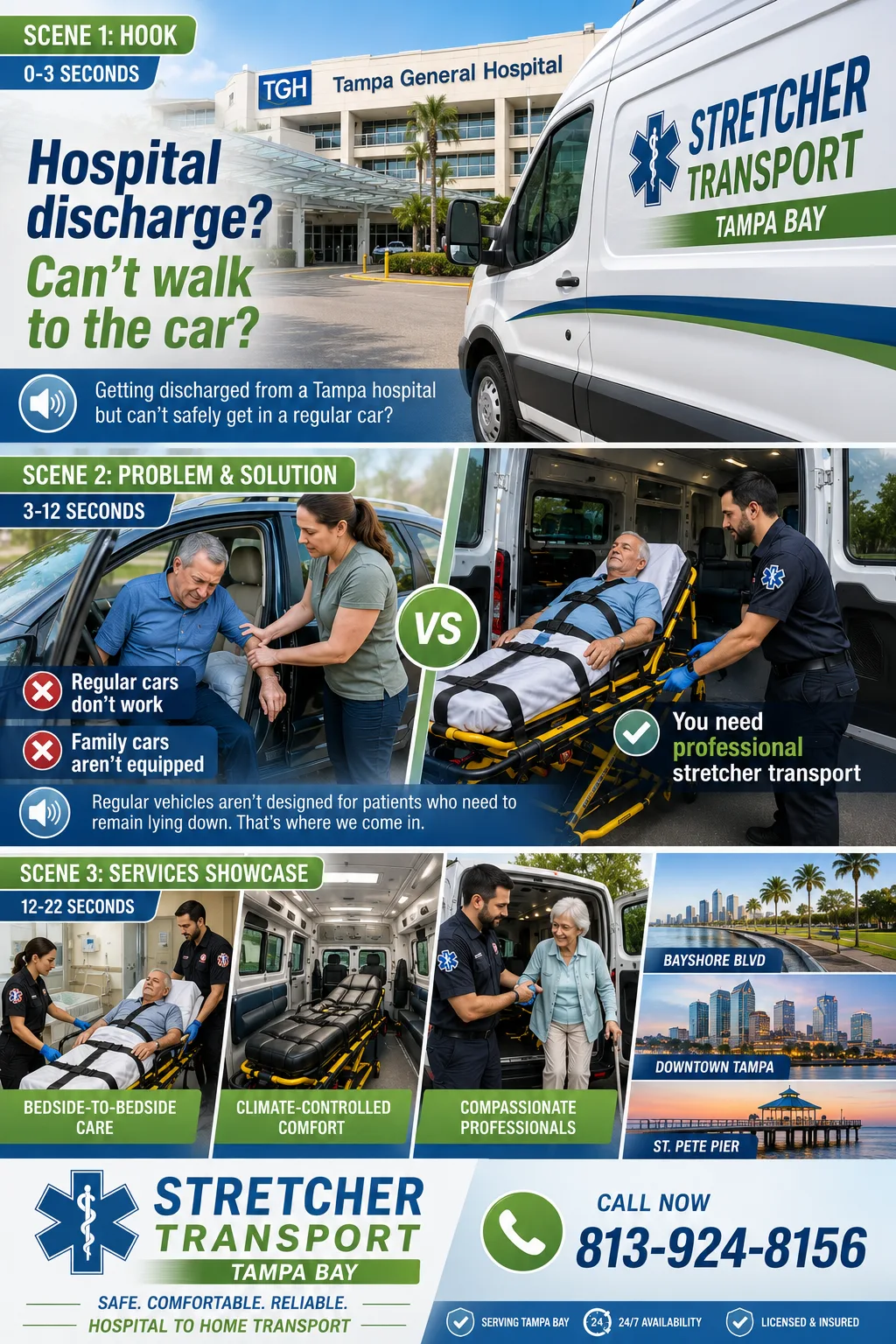
A two-person crew arrives in a dedicated stretcher van — not a converted minivan, not a rideshare with a folding cot. The vehicle is equipped with a mounted, floor-track-secured gurney and a hydraulic loading lift rated for safe patient entry.
The crew will identify themselves, confirm patient details, and walk the path from the patient's current location to the vehicle before any transfer begins. If there are obstacles — narrow hallways, stairs, tight doorways — they'll identify the safest route. You don't need to move furniture in advance, but if you can clear a 36-inch path from the front door to the bed before they arrive, it helps.
Step 3 — The Transfer
This is the part caregivers worry about most. The two-person transfer protocol exists precisely so that family members don't have to attempt this alone — and so the patient isn't jostled or repositioned unsafely.
One crew member manages the patient's upper body and head; the other handles the lower body and legs. They move together in a single, coordinated motion onto the gurney. Soft restraints go across the chest and legs — not restrictive, just there to prevent unintended shifting during transport. Then the gurney raises to travel height and rolls to the vehicle.
Your job during the transfer: Stay close, keep the patient calm, and let the crew work. If your loved one gets anxious about being moved, a familiar voice does more than any physical help you could offer.
Step 4 — En Route
Once loaded, the gurney locks into floor-mounted tracks. It doesn't shift during transit — that's by design. Climate control runs the whole trip, which matters more than people expect in Florida. Post-surgical patients and dialysis patients both tend to run cold, and a comfortable ride is part of the service.
Our crews are CPR and first aid certified. They're not paramedics and won't provide medical intervention — but they stay attentive throughout, and they keep the receiving location informed of arrival time so there's no scramble on that end.
Want to ride along? One family member or caregiver is always welcome in the front cabin.
Step 5 — Arrival and Bed Transfer
The crew doesn't drop your loved one at the door and drive off. They stay until the patient is transferred from the gurney to the receiving bed and settled comfortably. That's what "bed-to-bed service" actually means — not a marketing phrase but a commitment that nobody ends up at a curb.
For home discharges, the crew asks where the bed is, confirms any positioning instructions from the discharge team, and makes sure the patient is comfortable before they leave. Only then do they go.
Same-Day Stretcher Transport in Brandon, FL — How It Actually Works
Same-day availability is real. It's just not unlimited — and understanding how it works is the difference between securing a slot and getting turned away.
Stretcher transport operates differently from rideshares or standard medical transport. Every trip needs a two-person crew and a dedicated gurney van. When the schedule fills, it fills completely — there's no "just send one person" workaround. On a typical Brandon weekday, same-day slots are gone by mid-afternoon. Not sometimes. Regularly.
The Before-Noon Rule — and Why It Exists
The single most important thing to know about same-day stretcher transport: call before noon.
This isn't arbitrary. Hospital discharge waves in Brandon follow a predictable pattern. The heaviest discharge window runs from 9:00 AM to 11:00 AM — that's when HCA Florida Brandon and TGH Brandon Healthplex release the bulk of overnight patients. By the time those discharges are confirmed and families start making calls, the morning slots are already competing for the same afternoon crew availability.
If you call before noon, you're booking into an afternoon window that hasn't been claimed yet. If you call at 2:00 PM asking for a 3:00 PM pickup, the honest answer is often no.
The pro move: call the moment discharge is mentioned — not when it's confirmed. You can always cancel or adjust the time. You cannot manufacture a slot that doesn't exist.
What to Say When You Call
Don't call and say "I need a stretcher transport." Dispatchers need specifics to confirm whether the trip is feasible. Use this script:
"I need a same-day stretcher transport today in Brandon. The patient is [name], approximately [weight] pounds, with a supine order. Pickup is [location/room], drop-off is [address]. Can you confirm availability and give me a quote?"
That one call covers every question the dispatcher needs to answer. It signals that you know what you're asking for, which speeds up the confirmation process considerably.
Why Online Booking Doesn't Work for Same-Day
Online booking systems work well for scheduled, advance trips. They are not built for urgent same-day coordination. A form submission has to be reviewed, matched to availability, and confirmed — a loop that can take hours.
For same-day service, that lag is the difference between a secured slot and a missed discharge. Always call. The phone line at (813) 924-8156 reaches a live dispatcher, not a queue.
A Note on Peak Times to Avoid
If you have any flexibility at all, avoid requesting pickup between 9:00 AM and 11:00 AM. That window is the hardest to fill for last-minute requests because it competes with pre-scheduled morning discharges. Afternoon pickups — especially 1:00 PM to 4:00 PM — have significantly better same-day availability in the Brandon service area.
Stretcher Transport Cost in Brandon, FL — What You'll Actually Pay
Honestly, no other Brandon-area NEMT provider publishes cost guidance. We think families deserve to know what they're working with before they pick up the phone — so here it is.
The Honest Cost Framework
Private stretcher transport costs more than wheelchair transport. That's not padding — it's a genuine operational difference. Every stretcher trip requires a two-person crew, a dedicated gurney van, and more time at both ends for the transfer. Those aren't optional.
What it isn't: ambulance pricing. A BLS (Basic Life Support) ambulance in Hillsborough County can run $1,500–$3,000 or more for a non-emergency trip. Private NEMT stretcher service costs a fraction of that for medically stable patients who don't need paramedic-level intervention on board.
What Affects Your Quote
When you call for a quote, the dispatcher will calculate based on:
Mileage — the primary cost driver. A Brandon-to-Brandon discharge (e.g., HCA Brandon Hospital to Bloomingdale) costs less than a Brandon-to-Tampa transfer.
Service level — standard stretcher vs. bariatric stretcher (patients over 350 lbs require specialized equipment and may require additional crew)
Special equipment — oxygen tanks, IV poles, and other gear are accommodated; disclose these upfront
Timing — pre-scheduled trips are priced at standard rates; urgent same-day requests may carry a premium depending on availability
Quotes are provided upfront before confirmation. There are no surprise charges at delivery.
Insurance, Medicaid, and Medicare — the Real Picture
Most providers dance around this. We won't.
Florida Medicaid NEMT: Medicaid covers non-emergency medical transportation for eligible patients — but every trip routes through a managed care broker (MTM or a similar contracted broker, depending on your plan). The broker controls scheduling, provider assignment, and approval. Call your plan's member services line and ask: "Is stretcher transport covered, and do I need prior authorization?" Budget 24–48 hours minimum for broker coordination. That's why Medicaid NEMT and same-day service rarely mix.
Medicare Advantage: Some Medicare Advantage plans cover NEMT as a supplemental benefit. Coverage varies significantly by plan — sometimes dramatically. Always ask specifically about stretcher transport, not just "medical transport."
Private pay: No prior authorization. No broker delays. You call, we confirm, we show up. For anyone who needs same-day service or wants to choose their provider directly, private pay is the straightforward path.
Still not sure whether your plan covers the trip? Call us anyway. We can often help you figure out the right questions to ask your insurer before you commit.
How to Prepare Your Home (or Facility) Before the Crew Arrives
Most families pour all their energy into the hospital side of the discharge. The home side gets forgotten — and that's exactly where trips slow down, get complicated, or go sideways.
A crew arriving to find a blocked doorway, a bed flush against the wall, or a gate code nobody wrote down will still get the job done. But it takes longer, and longer means more stress on the patient. Five minutes of prep makes a real difference.
The Pre-Transport Home Checklist
Pathways:
Clear a minimum 36-inch path from your front door (or primary entry) to the patient's bed
Remove throw rugs, power cords, and anything a gurney wheel could catch
If the bedroom door swings inward and the room is small, prop it open all the way before the crew arrives
Note any steps between the entry and the bed — inform the dispatcher when you book
Access:
Gate codes, door codes, elevator key requirements — text these to the dispatcher after your call so the crew has them before arrival
If you live in a gated community in Riverview, Valrico, or Bloomingdale, confirm the guest entry process ahead of time; some gates require a call-ahead
At the destination bed:
Pull the bed slightly away from the wall — the crew needs access from both sides for a safe transfer
Have a flat pillow and light covering ready; patients coming off dialysis or surgery are often cold
If the patient uses a hospital bed at home, lower it to the lowest position before the crew arrives
Paperwork to have ready:
Discharge summary and medication list (the crew doesn't need these, but you'll want them at arm's reach)
Any positioning instructions from the discharge team — "keep head elevated 30 degrees" or "do not turn onto left side" — tell the crew before transfer, not after
Insurance card if you haven't already handled payment
One caregiver can ride along. If that's you, bring your phone charger, a light jacket (the van is climate-controlled), and whatever you'd want for a 30–60 minute ride. You ride in the front cabin while the crew attends to the patient in the rear.
What Makes Brandon Stretcher Transport Different — A Note From Marqus
Let me be direct about something, because families deserve honesty over marketing language.
Some NEMT companies operating in the Brandon market list stretcher transport on their websites but don't actually run dedicated gurney vans. They run wheelchair vans and improvise. A family calls in crisis, they're told "we can accommodate" — and then a single driver shows up with equipment that wasn't built for a patient with a supine order.
That's not hypothetical. Discharge coordinators at HCA Brandon and TGH Healthplex have told us about it directly — providers who no-showed or arrived with the wrong equipment, leaving the care team scrambling.
What we actually run: purpose-built stretcher vans with floor-mounted gurney tracks, hydraulic lifts, and a two-person crew on every single trip. Not sometimes. Every trip. That's not a policy choice — it's a physics requirement. The math on a single-person stretcher transfer doesn't work safely for the patient or the operator.
I started this company after 15 years building service businesses in Florida, with a PMP certification and direct experience in healthcare operations. What pushed me into NEMT specifically was watching families navigate the gap between "stable enough to leave the hospital" and "able to use a regular vehicle" — and finding nothing in the Brandon market that served that gap reliably.
Voyage Tampa's community highlights series featured a profile on how this company started and what drives the work — it's the most direct account of who runs this operation and why. For families wanting to vet a provider before trusting them with a loved one, that's the place to start. For case managers and discharge planners at Brandon-area facilities: our NEMT license number, insurance certificates, and vehicle inspection records are available on request. We work directly with discharge teams at HCA Florida Brandon, TGH Healthplex, AdventHealth, and St. Joseph's, coordinating on discharge windows, medication transfer protocols, and receiving facility confirmation so your team doesn't have to babysit the handoff.
Community standing matters in this business, and ours is verifiable. We're an active member of the Hillsborough Black Chamber of Commerce — one of the most respected professional networks for minority-owned businesses in the Tampa Bay region — and our business is listed with the Upper Tampa Bay Chamber of Commerce, which provides independent verification of our professional standing, service area, and operational legitimacy. Both affiliations are publicly verifiable before you ever pick up the phone. A company that shows up in the community before you need them is more likely to show up on discharge day.
💬 For case managers and discharge planners: Call (813) 924-8156 and ask for the provider coordination line. We'll give you a direct contact for ongoing referral coordination — not a general intake queue.
Brandon Hospitals and Facilities We Serve
We coordinate directly with discharge planners and case managers at the following Brandon-area facilities. If your loved one is being discharged from one of these locations, we already know the layout, the entrance protocols, and the discharge team's preferred coordination process.
HCA Florida Brandon Hospital — Our most common pickup location. We monitor discharge confirmation windows and arrive at the correct hospital entrance (not the main lobby — the dedicated patient discharge bay). Families should notify the nursing staff that a stretcher transport is en route so the floor is ready when we arrive.
TGH Brandon Healthplex — Same-day stretcher transport available. Coordinate your discharge time with the case manager and give us at least two hours of lead time for afternoon pickups.
Fresenius Medical Care (Brandon locations) — We provide recurring stretcher transport for dialysis patients who cannot sit after treatment. Weekly and thrice-weekly scheduling available. We time arrivals to coincide with treatment end to minimize wait time in the facility.
DaVita Dialysis (Brandon/Riverview) — Same recurring service model as Fresenius. Post-dialysis positioning support included — we adjust the stretcher angle based on how the patient is feeling at pickup.
Brandon Health and Rehabilitation Center — Skilled nursing facility transfers to home or alternate facility. We coordinate with the charge nurse on transfer paperwork and receiving location confirmation.
Surrounding communities served: Riverview, Valrico, Seffner, Lithia, Apollo Beach, Sun City Center, and Plant City. Response times and same-day availability vary by distance from Brandon — call to confirm your specific address.
See It in Action: Stretcher Transport the Way It Should Work
Reading about bed-to-bed service is one thing. Seeing it is another. This short video shows what professional stretcher transport actually looks like — the vehicle, the crew, the transfer process, and the level of care that should be standard on every trip.
If what you see matches what you're looking for — that's exactly what you'll get when you call (813) 924-8156.
Frequently Asked Questions
How do I book same-day stretcher transportation in Brandon, FL? Call (813) 924-8156 before noon and have the patient's name, weight, pickup location, supine order confirmation, and destination address ready. Same-day service is available based on crew availability — afternoon slots (1:00–4:00 PM) have the best availability. Do not use online booking for urgent same-day requests.
What is the difference between stretcher and wheelchair transport? Wheelchair transport is for patients who can sit upright safely for the duration of the ride. Stretcher transport is for patients who cannot sit up — due to a clinical supine order, post-surgical restrictions, severe mobility decline, or bed-bound status. Ask the nurse: "Does the patient have a supine order?" That answer determines which service you need.
Does Medicaid cover stretcher transport in Florida? Florida Medicaid covers NEMT for eligible patients, but routes all trips through a managed care broker (such as MTM). The broker controls scheduling and provider assignment. Budget 24–48 hours for broker authorization — same-day Medicaid NEMT is rarely possible. If you need same-day service, private pay is typically the only viable option.
What should a patient expect during a stretcher transport ride? The patient lies flat or semi-reclined on a secured medical gurney inside a dedicated van. The gurney is locked into floor-mounted tracks — it does not move during transit. The climate is controlled. A two-person crew monitors the patient throughout. One family member may ride along in the front cabin. The crew stays at the destination until the patient is safely transferred to their bed.
Can a family member ride along during stretcher transport? Yes. One caregiver is always welcome to ride in the front cabin. Bring your phone, a charger, and a light jacket — the van is climate-controlled and the ride typically runs 30–60 minutes for Brandon-area trips.
What if my loved one needs oxygen during transport? Disclose oxygen needs when you call to book. We accommodate O2 tanks and can configure the vehicle accordingly — but this must be arranged before dispatch, not at pickup.
The Bottom Line
Most families don't discover stretcher transportation until they need it urgently — and then they're figuring it out under the worst possible conditions. Now you're not in that position.
The most important things to carry with you: ask the nurse about a supine order before you book anything, call before noon for same-day service, use the phone for urgent requests, and make sure whoever you hire is running a real gurney van with a two-person crew — not improvising with equipment that wasn't built for the job.
You're not supposed to know all of this in advance. Nobody teaches families how hospital discharges work until they're standing in the middle of one. But now you do know — and that means when the moment comes, you won't be guessing. You'll be ready.
Call (813) 924-8156. We serve Brandon, Riverview, Valrico, Seffner, Sun City Center, and the greater Tampa Bay area. Same-day and pre-scheduled stretcher transport available.



A good username can make a profile stand out. This name generator helped me create several creative names instead of using random numbers and letters